

The United Nations Office at Geneva
Multimedia Newsroom
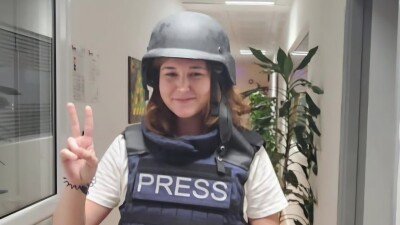
“I believe in nothing right now. Our press vests are turning us into targets and it's becoming a death sentence for us,” said Christina Assi .
On 13 October 2023, Ms. Assi - who was working as a photojournalist for Agence France Presse (AFP) - lost her right leg after two Israeli air strikes targeted the exposed hillside where she and other colleagues were observing the ongoing conflict between Israeli forces and Hezbollah militants.
This year’s commemoration of World Press Freedom Day on 3 May provided a moment to reflect on the fact that more journalists were killed in 2024 than in any other year since the Committee to Protect Journalists (CPJ) began collecting data more than three decades ago.
At least 124 journalists and media workers were killed last year, nearly two-thirds of them Palestinians killed by Israel, the CPJ data shows.
Ms. Assi stands among the few survivors, and she never imagined that she would be targeted simply for doing her job.
The day of the attack
She recounted the harrowing events of that day – one of her first major assignments, which quickly became the most traumatic experience of her life.
“It was starting to get dark and that's when we were about to leave and then suddenly, out of nowhere, we were targeted,” she said.
“The first time I was on the ground, I couldn't really understand what was happening, and I was screaming for help. So, my colleague Dylan rushed to help me and put a tourniquet on me. But then, like 40 to 47 seconds later, we were targeted again.”
After the second strike, Ms. Assi found herself alone beside a burning car. Bleeding and gravely injured, she had no choice but to crawl away to save her life.
“My press vest was too heavy, and the camera belt was suffocating,” she recalled. In that moment, she began to lose faith in international laws and conventions. “As journalists, we are left alone," she insisted.
The silence of the international community
For Ms. Assi, the international community’s response to the attack - including condemnations and UN calls for investigation - has been utterly ineffective.
“I do believe that we need more than words. We need concrete action and something to happen where that should lead to justice in one way or another. If it's not now, then later,” she said.
She strongly condemns the impunity with which attacks on journalists continue. “Our cases are being dismissed as collateral damage when, in fact, they are not. These are war crimes, and there should be a real investigation.”
The forgotten journalists of Gaza
Ms. Assi also emphasized that the same impunity applies to Palestinian journalists in Gaza, who have been documenting the war there since day one.
“They’ve been silenced, targeted in every possible way. It’s all over social media and in the news—and yet nothing has been done. No action has been taken to protect these journalists,” she said.
She pointed out that the lack of international presence hasn’t stopped the violence. “It's clear how horrific everything is. But the world hasn’t reacted the way it should have. No one has even tried to stop it.”
Carrying the flame
Nearly a year after losing her leg, Ms. Assi carried the Olympic torch in the French city of Vincennes, ahead of the Paris Games in July 2024.
It was more than a symbolic gesture but a powerful opportunity to pay tribute to her colleague, Reuters journalist Issam Abdallah, who was killed in the same attack.
“It was a great opportunity for us to honour all the fallen journalists and let the world and the international community and the Europeans and all those who didn't know about what happened to us, let them know about what happened,” she said.
STORY: Press vests becoming a target - war reporter Christina Assi
TRT: 03:18”
SOURCE: UNTV CH
RESTRICTIONS: ON-SCREEN CREDITS PLEASE SEE BELOW
LANGUAGE: ENGLISH/ NATS
ASPECT RATIO: 16:9
DATELINE: 20 MAY 2025 GENEVA, SWITZERLAND
1. Wide shot from helicopter of United Nations Interim Force In Lebanon (UNIFIL) patrol on the border of Lebanon and Israel.
2. SOUNDBITE (English) – Christina Assi AFP photojournalist: “Before this targeted attack, I believed in the international law, I also believed in the Geneva Conventions and all these laws that were put to protect journalists. However, after we were targeted and after witnessing what's been unfolding for a year and a half and how journalists are being silenced and targeted without the world taking any action to protect them. Yeah all of this changed, and I believe in nothing right now. I feel like we are as journalists, we are left alone. And yeah, our Press vests are turning us into targets and it's becoming a death sentence for us.”
3. Photo of Christina Assi with the Reuters journalist Issam Abdallah who died on the 13th of October, the same day Christina Assi was injured. Please credit Christina Assi.
4. Video of Christina Assi with the Reuters journalist Issam Abdallah who died on the 13th of October, the same day Christina Assi was injured. Please credit Christina Assi.
5. SOUNDBITE (English) – Christina Assi AFP photojournalist: “We have been covering in the South for almost a full day. We were there from the morning covering the UN patrolling and everything, and it was relatively calm. It wasn't until around 4 to 4:30 p.m., something like that, we heard that there were clashes and bombardment in a village nearby. So, we all - a group of seven journalists- we all headed to Alma al-Shaab to a hill that was exposed and known to journalists.”
6. Medium shot of Alma al-Shaab where journalist were filming the clashes on the border between Israel and Lebanon. Please credit Christina Assi.
7. SOUNDBITE (English) – Christina Assi AFP photojournalist: “Then suddenly, out of nowhere, we were targeted. The first time I was on the ground, I couldn't really understand what was happening, and I was screaming for help. So, my colleague Dylan rushed to help me and put me on the tourniquet. But then, like 40 to 47 seconds later, we were targeted again.”
08. Photo of Christina Assi covering the clashes on the border between Israel and Lebanon. Please credit Christina Assi.
09. SOUNDBITE (English) – Christina Assi AFP photojournalist: “Everyone was injured after the second attack, and I was left alone, next to an Al Jazeera car that was burning. So, I had to do something to save myself. And the only way was for me to crawl away from the fire with my severe injuries and I was bleeding as well. So, I tried my best to crawl away from the fire. The camera belt was suffocating me. The Press vest was too heavy.”
10. Medium shot United Nations Interim Force In Lebanon (UNIFIL) patrol on the border of Lebanon and Israel.
11. SOUNDBITE (English) – Christina Assi AFP photojournalist: “Until today, no one was held accountable for what happened to us, and we don't even know, who was the soldier who decided to fire a tank shell on us twice and then open a machine gun open also on us.”
12. Video of Christina Assi in the hospital getting treatment after her major injury and leg imputation. Please credit Dylan Collins.
13. SOUNDBITE (English) – Christina Assi AFP photojournalist: “So everything is still unclear, all what we've received so far is just words, but I do believe that we need more than words. We need, a concrete action and something to happen where that should lead to justice in a way or another. If it's not now, then later.”
14. Photo of Christina Assi in her Press vest. Please credit Christina Assi.
15. SOUNDBITE (English) – Christina Assi AFP photojournalist: “I hope just one day, like all this stuff will be taken into consideration because they are war crimes and there should be an investigation to these war crimes.”
Similar Stories

1
1
1
Edited News | OCHA , UNICEF , WFP
Aid agencies warned on Friday of the fast-developing humanitarian emergency inside Taiz City in Yemen, which has been encircled by de facto Houthi forces fighting government troops along the country’s west coast.

2
17
1
2
Edited News , Press Conferences , Images | OCHA , WMO
Two UN agencies teamed up on Wednesday to issue an appeal for immediate assistance to help communities already being impacted by the strongest El Niño on record.

3
16
2
2
Edited News , B-roll , Conferences , Images | UNITED NATIONS , UNOG
Sixth Consultative Meeting on Enhancing Coordination of Peace Initiatives and Efforts for Sudan

1
1
1
Edited News | UNICEF , WHO , UNHCR
Yemen war continues to force families from homes amid hunger and disease
More than 250,000 people have now fled renewed fighting in Yemen, the UN said on Tuesday, citing particular concern for those sheltering in the southwestern city of Taiz and the wider governorate, where access is “essentially blocked”.

1
1
1
Edited News | UNICEF
A little over one year since a ceasefire agreement was announced between Hamas fighters and Israel, more than 340 children have been reported killed and hundreds more injured, the UN Children’s Fund, UNICEF, said on Friday.

1
1
1
Edited News | UNICEF , IFRC
Six weeks after Nepal’s deadly flooding disaster, communities are still struggling to rebuild their lives, but they will need sustained help as global warming increases the risk of another Himalayan catastrophe, the UN Children’s Fund (UNICEF) said on Friday.

1
1
1
Edited News | WHO
In suspected Russia plague death, testing and monitoring underway – WHO
The death of a lab worker in Russia’s Siberia region has sparked concerns about plague being the cause, the UN World Health Organization (WHO) said on Tuesday, adding that it was following the situation closely.

1
1
Edited News | OHCHR , UNOG
UN Human Rights Chief Volker Türk on Friday provided and oral update to the 63rd session of the Human rights Council on Ukraine.

1
1
1
Edited News | OHCHR , UNOG
UN Human Rights Chief Volker Türk on Friday provided and oral update to the 63rd session of the Human rights Council on the human rights situation in Haiti.

1
1
1
Edited News | WHO
Repeated delays in bringing lifesaving medicines, prosthetics and more from Israel into Gaza risk having devastating consequences on Palestinians who urgently need them in the wartorn enclave, the UN World Health Organization (WHO) said on Friday. “A truck full of non-priority supplies or the right supplies arriving too late, doesn't save lives. That's the question that actually matters," said Dr Reinhilde Van De Weerdt, WHO Representative in the OPT.

1
1
1
Edited News | WHO
DRC: Early access to care and oxygen decisive for Ebola patients’ survival – WHO
In the Democratic Republic of the Congo (DRC), health workers fighting the country’s largest-ever Ebola outbreak are struggling to overcome critical challenges to patient care, the UN World Health Organization (WHO) warned on Tuesday.

1
1
1
Edited News | OCHA , UN
Civilians in Iran are continuing to feel the consequences of months of conflict and military escalation, the UN’s top official in the country has said, as loss of life, damage to civilian infrastructure and mounting economic pressures leave many facing continued uncertainty.